
Human Rights
-
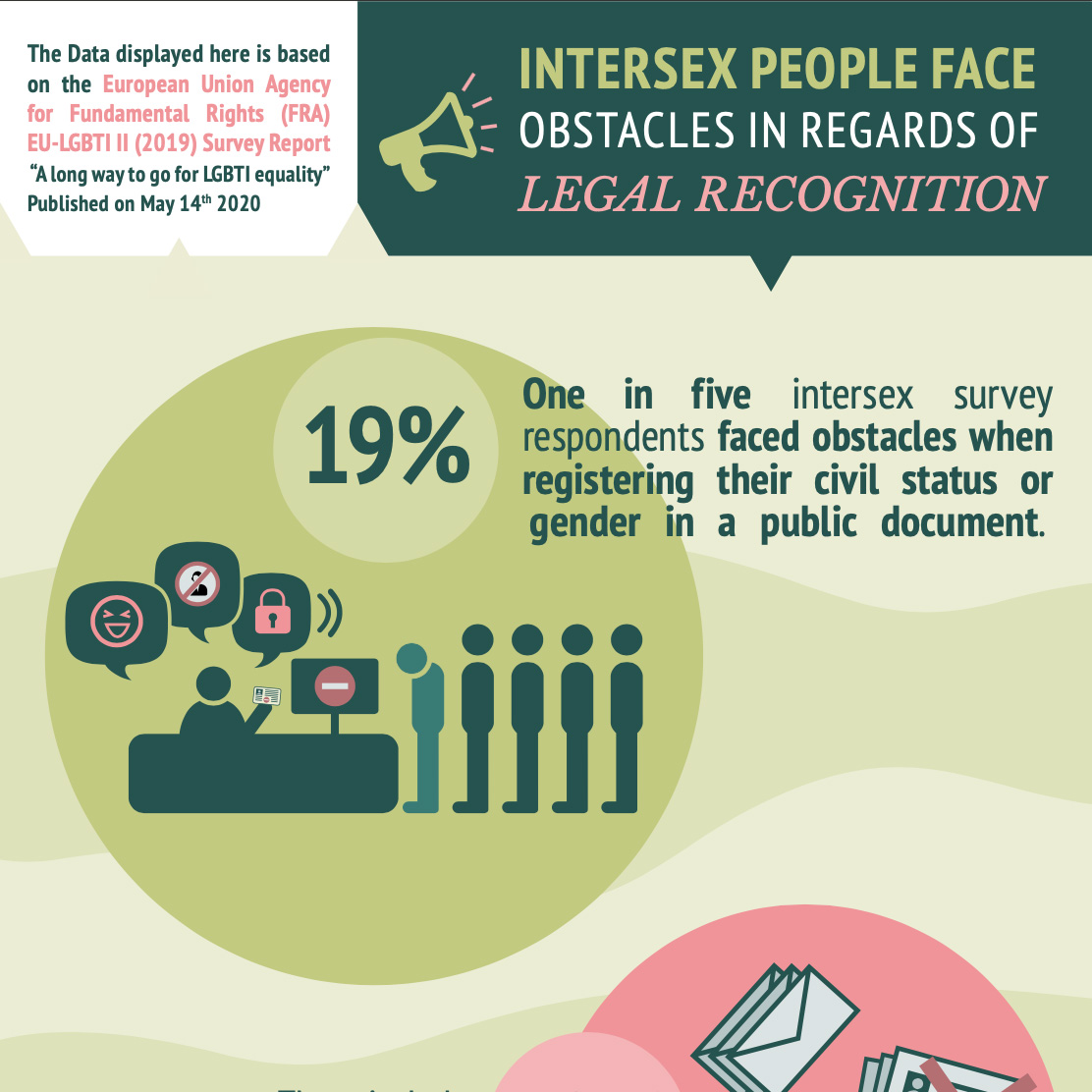
Intersex People face obstacles in regards of legal recognition
Everyone has the right to respect for their private life. This is what we read in the EU Charter of Fundamental Rights (Article 7) and in the European Convention on Human Rights (Article 8). Gender identity is a crucial aspect in the development of everyones self-image, and intersex people, like anyone else, have the right…
-

Intersex people in Europe face housing and economic difficulties
For the first time, the FRA LGBTI Survey 2019 shows us statistical data on the issues of housing and economic difficulties for intersex people living in Europe. Among all LGBTI respondents intersex people are the group with the highest rates of difficulties. In addition, as pointed out in the editorial comment in our infographic, intersex…
-
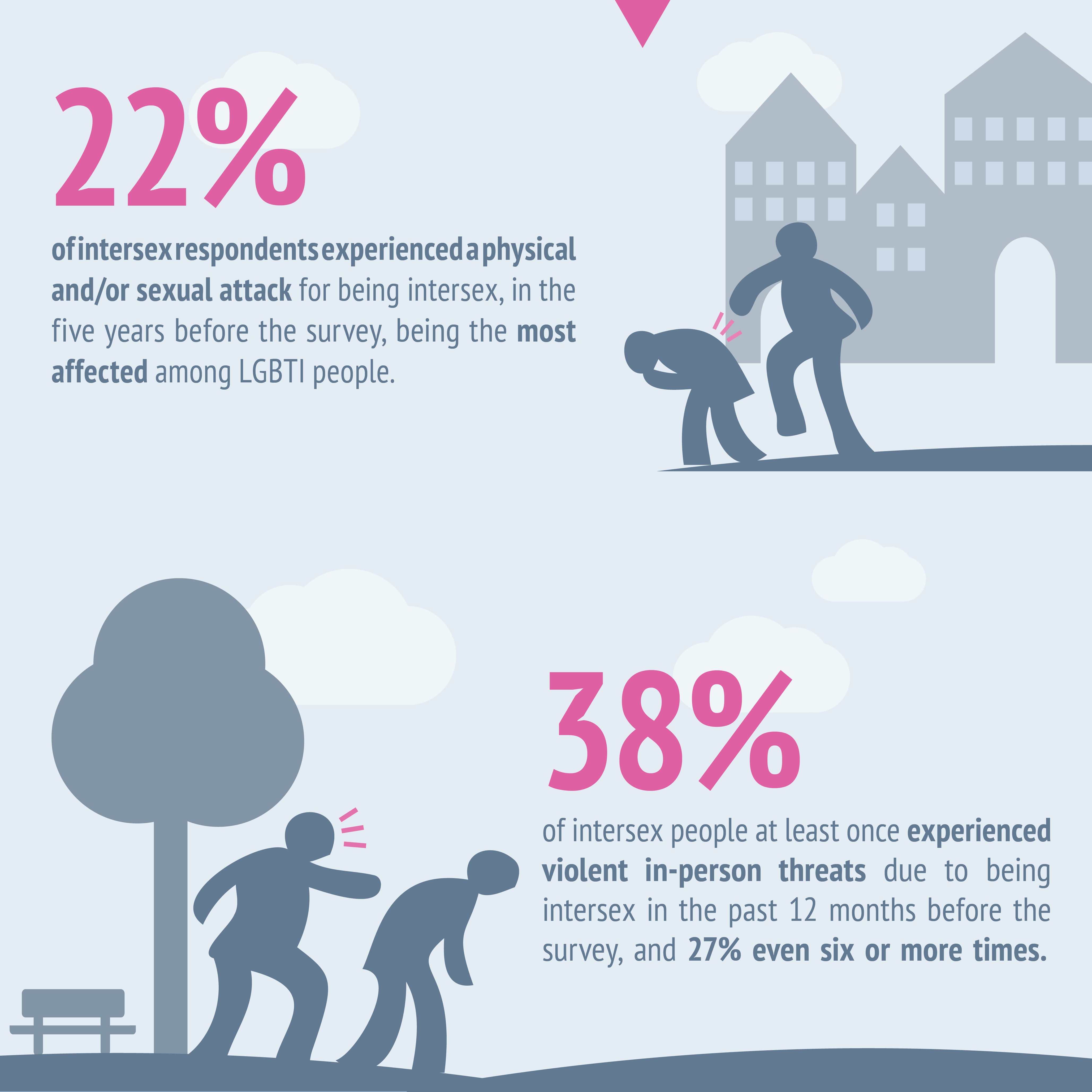
Intersex people in Europe face physical violence and harassment
Unfortunately, as the latest FRA LGBTI report reveals, many intersex people in Europe suffer from physical and sexual attack based on being intersex. They even turn out to be the most affected among all LGBTI people (see the infographic below). Therefore, we appeal to the Yogyakarta Principles on on the application of international human rights…
-
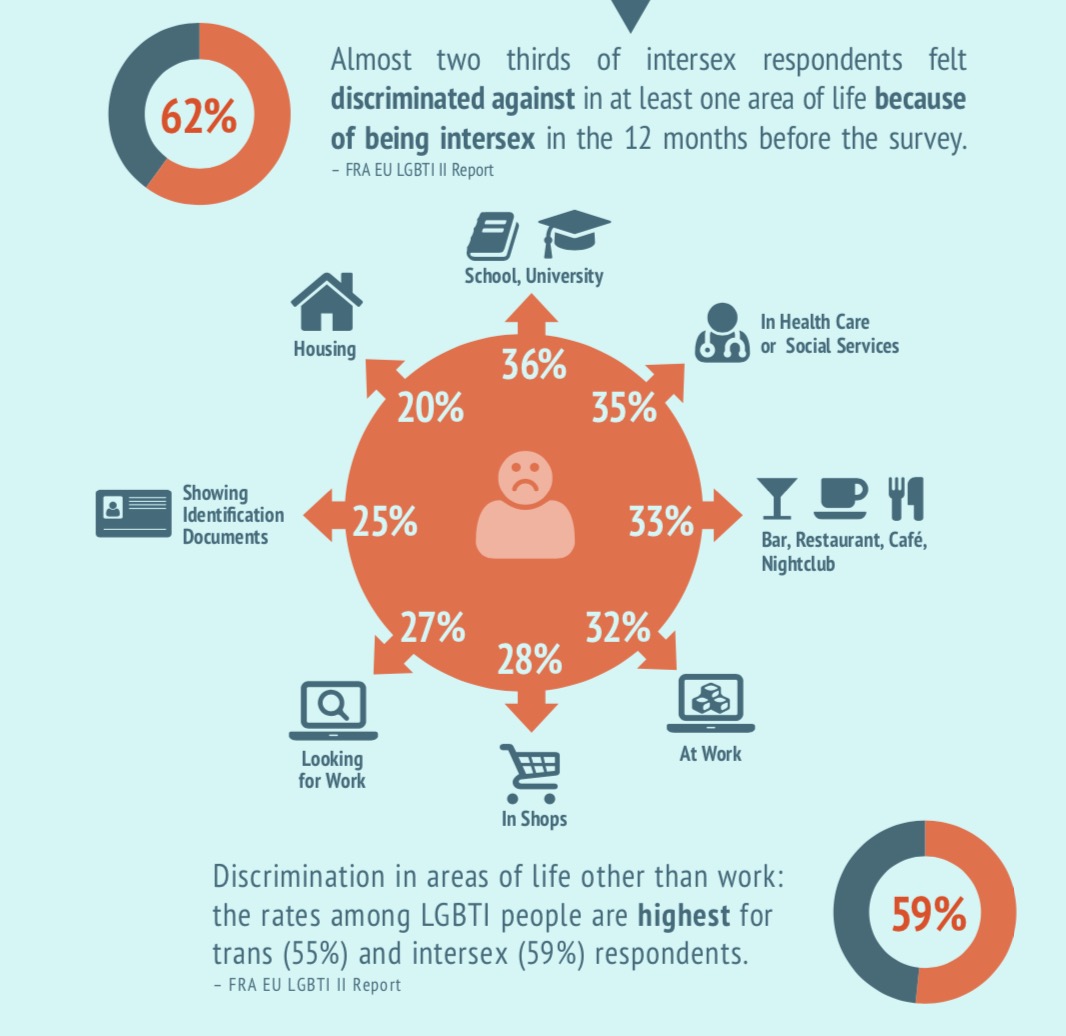
Recent survey shows high rate of discrimination of intersex people in Europe
It was on December 10th, 1948 when the United Nations General Assembly proclaimed that “all human beings are born free and equal in dignity and rights” and “all are entitled to equal protection against any discrimination” (Universal Declaration of Human Rights, Articles 1 and 7). One world speaking up with one voice for equality and…
-

Recent survey shows high rate of medical interventions on intersex people lack consent
Intersex people are still subject to invasive and often irreversible medical or surgical treatments to modify their sex characteristics, mainly to align them to social standards of so-called male and female bodies. As the latest FRA EU-LGBTI II Survey Report confirms, the majority of such treatments lack the free and informed consent of the person…
-

A groundbreaking resolution has been adopted by the UN Human Rights Council on the elimination of discrimination against women and girls in sport.
A groundbreaking resolution has been adopted by the UN Human Rights Council on the elimination of discrimination against women and girls in sport. For the first time it notes with concern the discrimination faced by women and girls born with variations of sex characteristics. It also recognizes that sport regulations and practices can reinforce harmful…
-

A Milestone for Intersex Rights: The European Parliament adopts landmark resolution on the rights of intersex people
Today, on the 14th of February 2019, the European Parliament has adopted a landmark Resolution on the Rights of Intersex People. By adopting this resolution, the European Parliament sets a clear standard within the European Union for the protection of intersex people’s bodily integrity and human rights. The resolution complements the ground-breaking 2017 intersex resolution…
-

List of intersex specific shadow reports to UN committees from CoE Region and from countries monitoring the CoE Region – Update March 2024
Download our list of intersex specific shadow reports from CoE Region and from countries monitoring the CoE Region with links to them | March 2024 NOTE If any of the links doesn’t work or isn’t clickable please copy the link and paste it in your browser’s address bar.
-
WHO publishes ICD-11 – and no end in sight for pathologisation of intersex people
Find a Spanish version here. On June 18 2018, the World Health Organization published the new International Classification of Diseases in its 11th version, which will be presented for final approval to the World Health Assembly in 2019. It is the first time since 1992 that the ICD has been reviewed. On positive note trans…
-
International Intersex Human Rights Movement – Resource List
Download our list to the international intersex human rights movement with links to Human Rights documents adressing intersex and important events
-

ZALAGANJE ZA LJUDSKA PRAVA INTERPOLNIH OSOBA – KAKO MOŽEŠ DA POMOGNEŠ?
We are excited to present the Serbo-Croatian translation of our toolkit “Standing up for the human rights of intersex people – How can you help?”
-
Az Interszex emberek emberi jogainak védelme. Hogyan segíthetsz te?
OII Europe is exited to announce the translation of “Standing up for the human rights of intersex people – How can you help?” into Hungarian. The translation of the Toolkit was initiated by Magyar LMBT Szövetség and we, at OII Europe, would like to congratulate them on this great work! Check out Az Interszex emberek…
