
Press Release – Launch of the Good Practice Map 2025
Today, on the 18th of May 2026, OII Europe is proud to launch its Good Practice Map 2025! This year, we celebrate a particularly special map edition, which highlights some groundbreaking advancements towards better protection of intersex human rights across Europe, in a year simultaneously marked by unprecedented challenges for our movements.
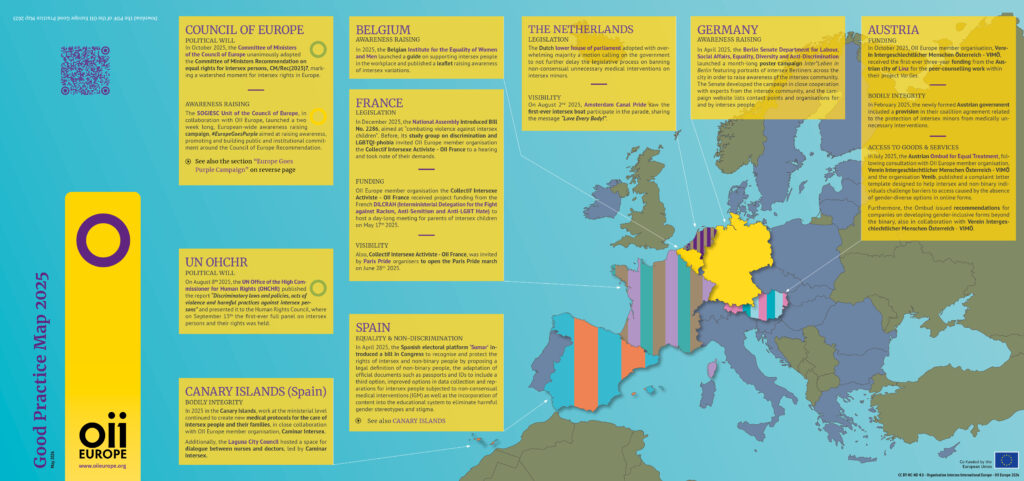
The 2025 map edition features good practices related to political will, bodily integrity, legislation, funding, access to goods and services, visibility, equality and non-discrimination, as well as an expanded section on awareness raising.
“The year 2025 marked a watershed moment for intersex human rights in Europe with the unanimous adoption of the Council of Europe Committee of Ministers’ Recommendation on Equal Rights for Intersex Persons,” says Dan Christian Ghattas, Executive Director of OII Europe, “We warmly welcome this long anticipated and groundbreaking European good practice, which sets out the most comprehensive framework to date for protecting the human rights of intersex people by providing thorough guidance to Member States on closing persisting legal gaps, particularly as related to prohibiting intersex genital mutilation (IGM), as well as recognising sex characteristics as a necessary protected ground for discrimination. And we thank the SOGIESC Unit of the Council of Europe for the great collaboration on the joint #EuropeGoesPurple awareness raising campaign tied to the Recommendation, which drew participants and illuminated skylines in purple across the Region to mark this momentous occasion.”
“Furthermore, other significant and groundbreaking work took place in 2025 at the international level, where at the United Nations Human Rights Council in September, the first-ever full panel on intersex persons and their rights took place during the presentation of the OHCHR report on discrimination, violence and harmful practices impacting the lives of intersex people,” says Magda Rakita, Co-Chair of OII Europe, “These major developments and exemplary good practice examples at European and international level send an important message of hope to intersex persons across Europe and beyond.”
“We also saw yet again the key role of governments and politicians working hand in hand with intersex organisations to advance protections for intersex people against non-vital, non-consensual medical interventions – in The Netherlands, NNID worked alongside politicians, with the outcome that the lower house of parliament adopted a motion calling to stop any further delays in banning IGM,” adds Belgin Günay, Treasurer of OII Europe, “In France, the National Assembly listened to the demands of Collectif Intersexe Activiste (CIA) – OII France in the context of its study group on discrimination and LGBTQI-phobia, who, in parallel, continued their advocacy work towards banning IGM; in December we saw the French National Assembly introduce a bill aimed at combating violence against intersex children. Similarly, in Austria, the newly formed government included a provision in their coalition agreement related to the protection of intersex minors from IGM.”
“Also in Austria, we celebrated that the Ombud for Equal Treatment, following consultation with Verein Intergeschlechtliche Menschen Österreich – VIMÖ, published a complaint letter template to help intersex and non-binary persons challenge barriers tied to the absence of third gender markers. In Spain, where the electoral platform Sumar introduced a bill in Congress to recognise and protect the rights of intersex and non-binary people in different areas of life, we saw similar important developments when it comes to legal gender recognition,” says Jana Hugo, Senior Policy Officer at OII Europe, “In the Canary Islands, we welcomed a good practice example related to bodily integrity, where work at the ministerial level to create new medical protocols for the care of intersex persons, in collaboration with Caminar Intersex, steadily advanced. This vital work was complemented by a session between nurses, doctors and activists, hosted by the Laguna City Council. ”
“Despite 2025 having been a year marked by continued backlash against intersex and LGBTIQ rights, we witnessed an important growth in intersex visibility at two key Pride events: at Paris Pride, the CIA – OII France were invited to open and lead the march by organisers, as well as in Amsterdam, at the Canal Pride, the first-ever intersex boat led the parade. The power of being visible and seen is not to be underestimated,” says Ins A Kromminga, Senior Awareness Raising & Campaigns Officer at OII Europe, “In Berlin, a month-long poster campaign Inter*Leben in Berlin featuring the portraits of intersex Berliners, was organised by the State Department for Labour, Social Affairs, Equality, Diversity and Anti-Discrimination. In Belgium, the Institute for the Equality of Women and Men published two important materials: a guide on supporting intersex persons in the workplace, and a leaflet on intersex variations, raising awareness, here too, of their lived realities.”
Lastly, 2025 was a year marked by the shattering of international funding structures following political developments in the US, which had devastating ripple effects on our movement. We therefore congratulate governments that continue to fund the vital work of intersex organisations. In France, CIA – OII France received project funding from the Interministerial Delegation for the Fight against Racism, Anti-Semitism and Anti-LGBT Hate, which allowed them to host a day-long meeting for parents of intersex children,” says Kristian Ranđelović, Co-Chair of OII Europe, “In Austria, VIMÖ received their first-ever three-year funding from the city of Linz for their peer-counselling work within the project Var.Ges, a central element in ensuring the sustainability of this work by remunerating the counsellors.”OII Europe and the European intersex movement’s vision is of a world where the human rights of intersex people are fully implemented, and where the bodily autonomy, physical integrity, and self-determination of all people are guaranteed. The 2025 Good Practice Map shows that despite a very challenging year of political and financial instability, significant good practices were implemented by various actors and activists, policymakers and politicians – whether big or small, whether internationally or at the local level – to continue advancing towards that shared vision: a world where intersex people are respected and celebrated as being part of human diversity and society.
Downloads
Content of the Good Practice Map 2025
Political Will
In October, the Committee of Ministers of the Council of Europe unanimously adopted the Committee of Ministers Recommendation on equal rights for intersex persons, CM/Rec(2025)7, marking a watershed moment for intersex rights in Europe.
The Recommendation was launched with a Presidency event in Strasbourg on October 27th under the Maltese Presidency of the Committee of Ministers where the Secretary General of the Council of Europe Alain Berset gave a keynote address, followed with speeches by
- Helena Dalli, Former EU Commissioner for Equality,
- Michael O’Flaherty, the Council of Europe High Commissioner for Human Rights,
- Irena Moozova, the Deputy Director International Dimensions of Justice Policies, Rule of Law and Equality, and the voices of intersex experts and partner organisations from across Europe, among others.
On August 8th, the UN Office of the High Commissioner for Human Rights (OHCHR) published the report “Discriminatory laws and policies, acts of violence and harmful practices against intersex persons” and presented it to the Human Rights Council, where on September 15th the first-ever full panel on intersex persons and their rights was held. Panel speakers included
- Ms. Nada Al-Nashif, Deputy High Commissioner for Human Rights,
- Ms. Tlaleng Mofokeng, Special Rapporteur on the Right to Health,
- representatives of UN member states groups, the Council of Europe and the European Union
- as well as Jeff Cagandahan, Executive Director of Intersex Philippines,
followed by interventions from the floor, which included five intersex activists from around the globe, including from Europe.
In October, the OHCHR and its European division collaborated with OII Europe for an online launch event for the report on October 16th, which included a presentation from the EU Fundamental Rights Agency.
The CM/Rec: https://www.coe.int/en/web/sogi/intersexrecommendation
Launch event: https://mycloud.coe.int/s/5JYpHZGfSr6Cmt7?dir=/&editing=false&openfile=true
OHCHR report: https://docs.un.org/en/A/HRC/60/50
UN HRC session: https://webtv.un.org/en/asset/k1w/k1wk3w7u6i
Legislation
The Dutch lower house of parliament adopted with overwhelming majority a motion calling on the government to not further delay the legislative process on banning non-consensual unnecessary medical interventions on intersex minors. OII Europe member organisation NNID worked alongside parliamentarians to achieve this good outcome, leading to the tabling and passing of the motion. The motion is accompanied by a growing number of local governments committing to intersex inclusion.
In France, the National Assembly’s study group on discrimination and LGBTQI-phobia invited OII Europe member organisation the Collectif Intersexe Activiste – OII France to a hearing and took note of their demands; the Collectif had resumed their work with members of parliament to ban intersex genital mutilation (IGM) in France, despite an unfavourable political climate, including by also raising awareness among politicains at the LGBTI+ committee of the Defender of Rights.
In December, the National Assembly introduced Bill No. 2286, aimed in particular at “combating violence against intersex children”.
French bill: https://www.assemblee-nationale.fr/dyn/17/textes/l17b2286_proposition-loi
Funding
In October 2025, OII Europe member organisation, Verein Intergeschlechtlicher Menschen Österreich – VIMÖ, received the first-ever three-year funding from the Austrian city of Linz for the peer-counselling work within their project Var.Ges, allowing the organisation to reimburse those coordinating the peer-counselling, as well as the peer-counsellors, a vital element in guaranteeing the sustainability of this important project.
OII Europe member organisation, Collectif Intersexe Activiste – OII France received project funding from the French DILCRAH (Interministerial Delegation for the Fight against Racism, Anti-Semitism and Anti-LGBT Hate) to host a day-long meeting for parents of intersex children on May 17th, which included workshops and in-depth conversations on how parents can best support their intersex child.
The gathering, part of their newly created PEVI parents network, was attended by six families, who were able to attend thanks to the ministerial funding. The meeting included an exhibition by illustrator Aude Nasr.
Var.Ges: https://varges.at/angebote/peer-beratung/
PEVI: https://pevi.fr/
Equality & Non-Discrimination
In April, the Spanish electoral platform ‘Sumar’ introduced a bill in Congress to
recognise and protect the rights of intersex and non-binary people by proposing a legal definition of non-binary people,
the adaptation of official documents such as passports and IDs to include a third option,
improved options in data collection,
reparations for intersex people subjected to non-consensual medical interventions (IGM),
as well as the incorporation of content into the educational system,
to eliminate harmful gender stereotypes and stigma.
Bodily Integrity
In February 2025, the newly formed Austrian government included a provision in their coalition agreement related to the protection of intersex minors from medically unnecessary interventions. Verein Intergeschlechtlicher Menschen Österreich – VIMÖ had reiterated in 2024 the need for a legal prohibition of non-consensual, medically unnecessary interventions on intersex minors, highlighting the importance to take into account the expertise of intersex organisations.
In 2025 in the Canary Islands, work at the ministerial level continued to create new medical protocols for the care of intersex people and their families, in close collaboration with OII Europe member organisation, Caminar Intersex.
Additionally, the Laguna City Council hosted a space for dialogue between nurses and doctors, led by Caminar Intersex.
Visibility
On August 2nd 2025, Amsterdam Canal Pride saw the first-ever intersex boat participate in the parade, sharing the message “Love Every Body!”. The boat was the initiative of the Dutch Spread the Word-intersex collective, and co-organised with OII Europe member organisation NNID.
The boat headed the Canal Pride parade, an important symbolic act which helped to raise the visibility of intersex persons.
OII Europe member organisation, the Collectif Intersexe Activiste – OII France, was invited by Paris Pride organisers to open the Paris Pride march on June 28th.
The Collectif opened the march with a powerful speech and held their banner at the head of the parade, distributing flyers and ran a stand at the pride village.
Amsterdam Canal Pride: https://www.instagram.com/p/DM2y9uwIKmC/?img_index=1
Paris Pride: https://www.instagram.com/p/DLhlTQvIAxp/
Access to Goods & Services
In July, the Austrian Ombud for Equal Treatment, following consultation with OII Europe member organisation, Verein Intergeschlechtlicher Menschen Österreich – VIMÖ and the organisation Venib, published a complaint letter template designed to help intersex and non-binary individuals challenge barriers to access caused by the absence of gender-diverse options in online forms.
Furthermore, the Ombud issued recommendations for companies on developing gender-inclusive forms beyond the binary, also in collaboration with VIMÖ.
Recommendations: https://www.gleichbehandlungsanwaltschaft.gv.at/aktuelles-und-services/aktuelle-informationen/emfehlung-fuer-geschlechtervielfalt-in-formularen.html
Awareness Raising
In Germany in April 2025, the Berlin Senate Department for Labour, Social Affairs, Equality, Diversity and Anti-Discrimination launched a month-long poster campaign Inter*Leben in Berlin featuring portraits of intersex Berliners across the city in order to raise awareness of the intersex community. The Senate developed the campaign in close cooperation with experts from the intersex community, and the campaign website lists contact points and organisations for and by intersex people.
The SOGIESC Unit of the Council of Europe, in collaboration with OII Europe launched a two week long, European-wide awareness raising campaign, #EuropeGoesPurple aimed at raising awareness, promoting and building public and institutional commitment around the Council of Europe Recommendation CM/Rec(2025)7 (see also the section POLITICAL WILL). From Intersex Awareness Day (October 26th), until Intersex Day of Solidarity (November 8th) institutions and individuals were invited to take part in various awareness raising actions under the unifying message: intersex people are seen, their lives are valued, and their equal rights must be recognised. The campaign included a dedicated website and material created by OII Europe together with the Council of Europe.
In 2025, the Belgian Institute for the Equality of Women and Men launched a guide on supporting intersex people in the workplace, aimed at helping employers, colleagues and unions better understand their legal rights, duties and responsibilities. The Institute also published a leaflet raising awareness of intersex variations to encourage intersex people who are victims of discrimination to contact the Institute.
Berlin Senate campaign: https://www.berlin.de/sen/lads/schwerpunkte/lsbti/kampagne-inter-leben-in-berlin-1514621.php
EuropeGoesPuple: https://www.europegoespurple.org
Guide: https://igvm-iefh.belgium.be/nl/documentatie/transgender-en-intersekse-personen-op-de-werkvloer
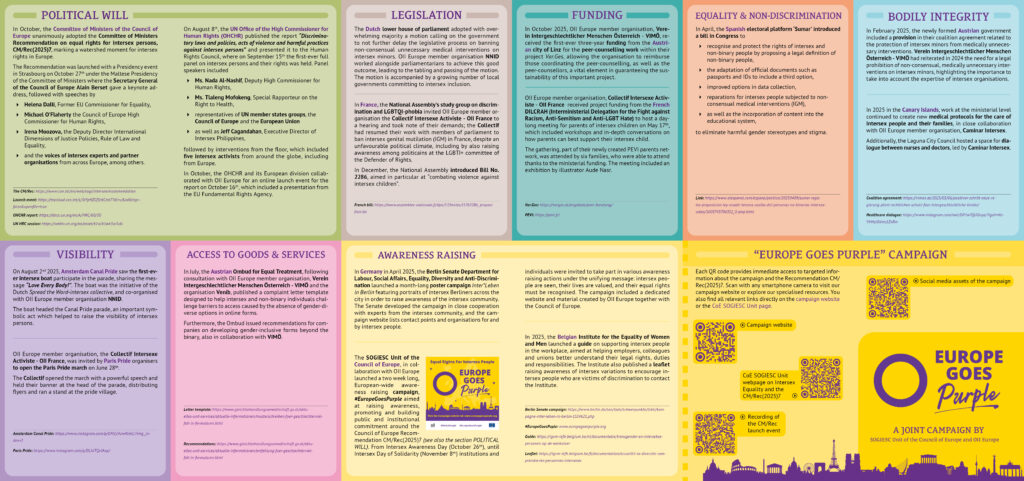
“Europe Goes Purple” Campaign
Visit the campaign website

