
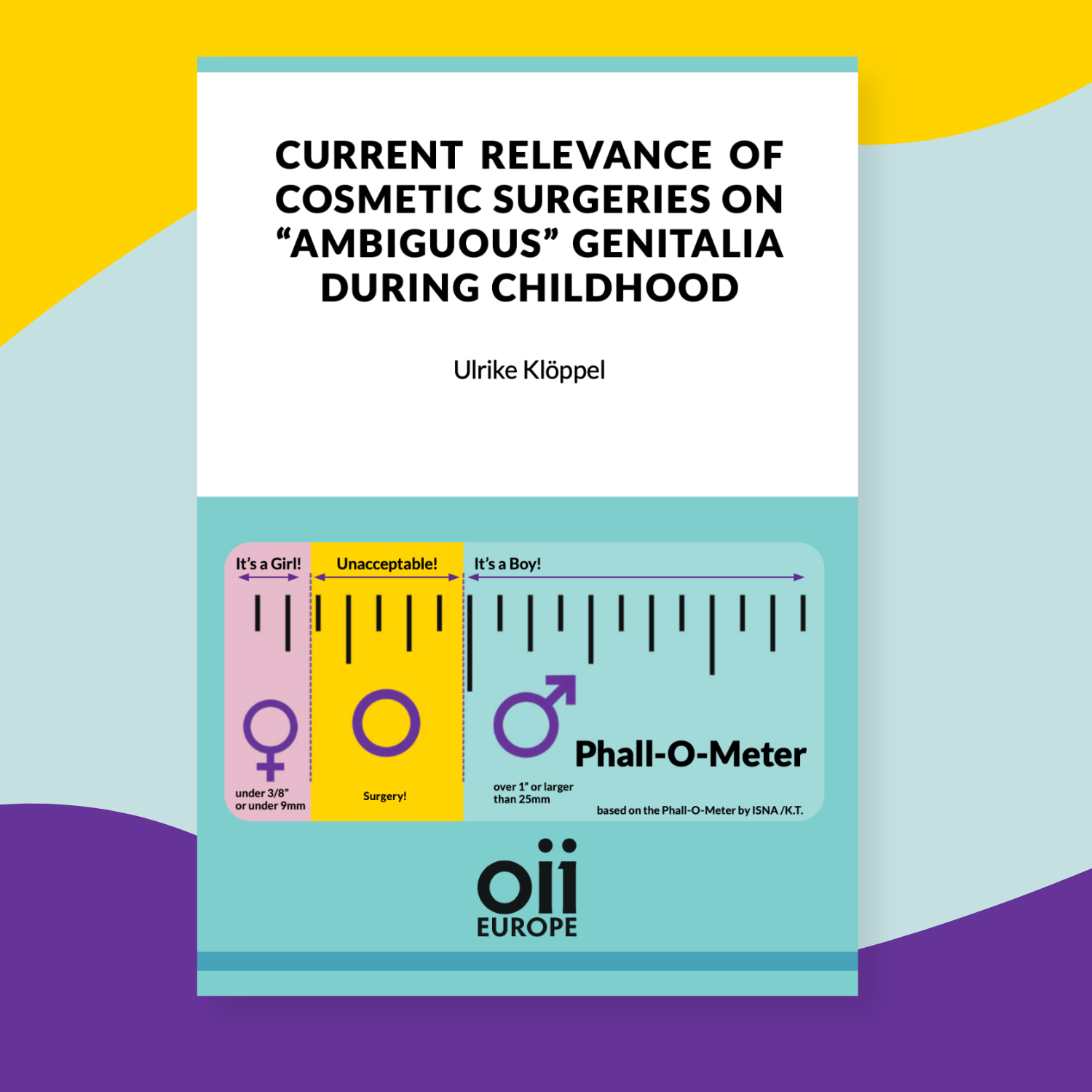
OII Europe is pleased to publish the English translation of Dr. Ulrike Klöppel’s landmark study “Zur Aktualität kosmetischer Operationen „uneindeutiger“ Genitalien im Kindesalter”. Originally published in German in 2016, the study remains one of the most important quantitative analyses of medically unnecessary genital surgeries performed on children with variations of sex characteristics in Germany.
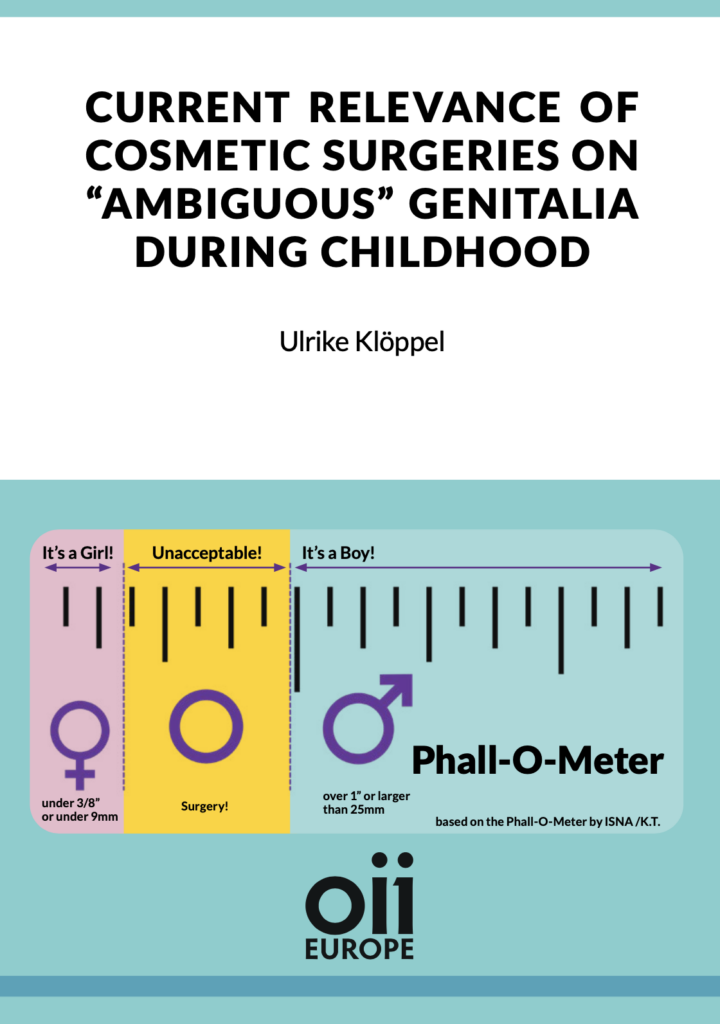
The study examines whether revisions to medical guidelines introduced from 2005 onwards led to a reduction in cosmetic genital surgeries performed on children who are too young to provide their own informed consent. Using nationwide hospital data collected by the German Federal Statistical Office, Dr. Klöppel analysed treatment cases and surgical procedures carried out between 2005 and 2014.
The findings challenge the assumption that changes in medical guidelines resulted in a significant reduction of such interventions. The study found that the overall frequency of feminising and masculinising surgeries performed on children under the age of ten remained largely constant throughout the period examined. While some decrease was observed for a narrowly defined group of intersex diagnoses, this was accompanied by stable or increasing numbers of surgeries performed under other diagnostic categories associated with variations of sex characteristics.
Among the study’s key findings are:
- No significant overall decrease in cosmetic genital surgeries on children with variations of sex characteristics between 2005 and 2014.
- Continued performance of feminising surgeries, including clitoral surgeries and vaginoplasties, on children too young to consent.
- Persistently high numbers of masculinising surgeries, particularly in cases diagnosed as hypospadias.
- Evidence suggesting shifts in diagnostic practices that may obscure the true extent of medical interventions on intersex children.
- A clear need for systematic and transparent monitoring of genital surgeries performed on children with variations of sex characteristics.
“The study provides crucial evidence that changes in medical recommendations alone are insufficient to protect children from medically unnecessary and irreversible interventions,” says Dan Christian Ghattas, Executive Director of OII Europe. “It demonstrates the importance of robust legal safeguards, accountability mechanisms and transparent data collection.”
Jana Hugo, Senior Policy Officer at OII Europe, adds: “Ten years after the period covered by this research, the findings remain highly relevant. Across Europe, as well as in Germany, intersex children continue to be subjected to interventions that can have lifelong consequences. This publication reminds us why governments must urgently implement human rights-based protections that guarantee bodily integrity, physical autonomy and self-determination.”
By making this important research available in English, OII Europe hopes to support policymakers, researchers, advocates and human rights institutions working to end medically unnecessary interventions on intersex children and to advance the protection of intersex people’s rights across Europe.
You can download the full publication below.
The aim of the study “Current relevance of cosmetic surgeries on ‘ambiguous’ genitalia during childhood” is to examine whether there has been a significant decrease in cosmetic surgeries on ‘ambiguous’ genitalia during childhood in Germany since 2005 by means of a retrospective statistical analysis.
Dr. Ulrike Klöppel
The Original German version was published by the Geschäftsstelle des Zentrums für transdisziplinäre Geschlechterstudien der Humboldt-Universität zu Berlin, Georgenstr. 47, 10117 Berlin, Germany. Ulrike Klöppel & Katja Sabisch, Bulletin – Texte 42, ISSN 0947-6822, December 2016.
