
OII Europe Submission to the UN Call for Inputs: general framework, architecture, and guiding principles of a legally binding instrument on the human rights of older persons
From the Introduction:
As OII Europe, we highly welcome the Call for Input for the general framework, architecture, and guiding principles of a legally binding instrument (LBI) on the human rights of older persons by the OHCHR, and happy to have submitted our input on the 22nd of April, 2026. Our societies are entering a time where the demographic is changing towards an ageing population that brings certain challenges for the human rights of older persons, such as ageism as a specific form of discrimination against older or perceived “older” persons.
As laid out in the Resolution adopted by the Human Rights Council[1] on 4 April 2024, intersex persons face multiple and intersecting forms of discrimination in all areas of life, including social security, health, employment and exercise of their legal capacity. The Report of the Office of the United Nations High Commissioner for Human Rights[2] adds by highlighting that “Discrimination is often compounded by intersecting factors such as gender, race, ethnicity and disability, among others.
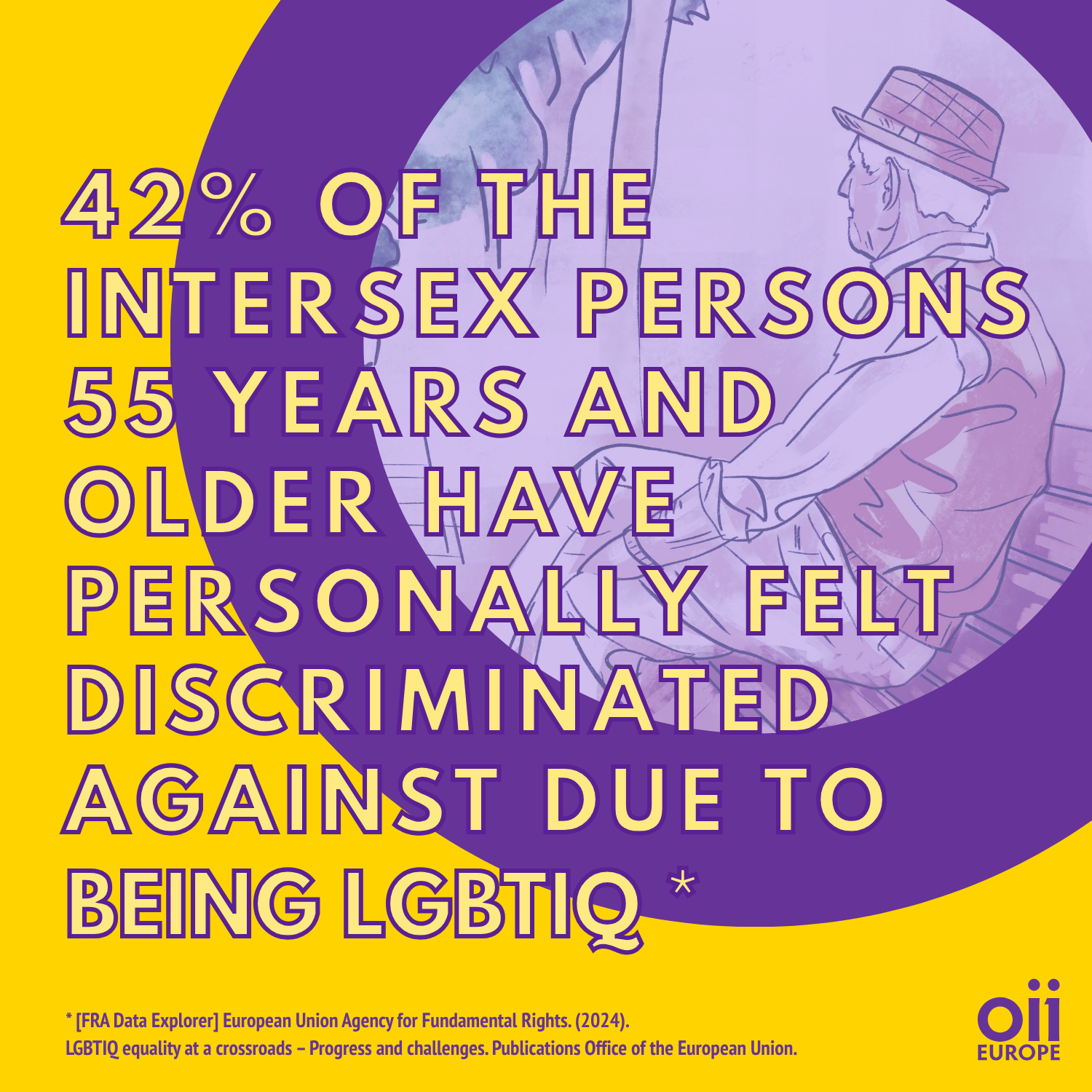
The 2023 LGBTI III Survey conducted by the EU Fundamental Rights Agency (FRA) found that intersex persons’ experiences of discrimination, hate speech and violence of all ages, but in particular intersex youth and older intersex people, are among the highest in the group of LGBTI respondents: 42% of the intersex persons 55 years and older have personally felt discriminated against due to being LGBTIQ [FRA Data Explorer][3]
An LBI which is inclusive of the diversity of all vulnerable groups will be able to empower older persons in all their diversity, reinforcing their ability to claim their rights, to participate meaningfully in public life, and shape the decisions that affect them. It would contribute to greater awareness of older people’s rights and help make existing human rights frameworks more effective and coherent in addressing the reality of living longer lives and intersecting forms of inequality. In doing so, it can mark a decisive step towards a more inclusive, equal and rights-based society for all ages.
[1] United Nations Human Rights Council. (2024, April 4). Combating discrimination, violence and harmful practices against intersex persons: Resolution adopted by the Human Rights Council on 4 April 2024 (A/HRC/RES/55/14). Retrieved from https://digitallibrary.un.org/record/4045699
[2] Office of the High Commissioner for Human Rights. (2025, August 8). Discriminatory laws and policies, acts of violence and harmful practices against intersex persons: Report of the Office of the United Nations High Commissioner for Human Rights (A/HRC/60/50). Retrieved from https://digitallibrary.un.org/record/4087307
[3]European Union Agency for Fundamental Rights. (2024). LGBTIQ equality at a crossroads – Progress and challenges. Publications Office of the European Union. https://doi.org/10.2811/569753 .
Download
To read the full submission please download the PDF below
